Showing posts with label #Syria. Show all posts

Friday, September 7, 2018

Arabs see Iran, not Israel, as enemy, Liberman tells Persian radio


Israel does not object to diplomatic and commercial ties between Syria and Iran, but it will never allow Iran to turn Syria into a forward military base, Defense Minister Avigdor Lieberman said Thursday in interview with Radio Farda.
Speaking to Iranian journalist Mehrdad Mirdamadi, Liberman told the Persian language network, which broadcasts to Iran from the Czech Republic, that Israel is not against “economic, diplomatic or other cooperation” between Syria and Iran, but it is completely opposed to Tehran establishing a “military presence and is opposed to its efforts to undermine the stability of the entire Middle East, the stability of our entire region.”
Liberman said that Tehran’s aggression in the region had led Arab nations to realize that Iran’s extremist regime was their enemy and not Israel.
“This may be the first time that moderate Arabs understand that their main enemy is not Israel and Jews and Zionism, but Iran’s radical and extreme regime,” Liberman said.
“This shift in attitude is because of the Iranian regime, and of course this is a step forward,” Liberman added.
The defense minister told Mirdamadi that Israel has no problem with the Iranian people. “Our problem with this regime is its dogma and every day we hear a speech that it seeks to destroy Israel and will never accept our existence.
“Iran’s access to nuclear weapons is the greatest threat to everyone’s stability,” he continued. “Iran’s political ambitions in combination with nuclear weapons will be problematic for everyone.
“Why does a country that has one of the largest oil reserves in the world spend so much on its nuclear program and on developing ballistic missiles?”
Liberman furthermore told Mirdamadi that “Iran invests in terror instead of employment for its young generation… It is a fanatical regime that in Syria alone has spent $13 billion and spends $2 billion every year in financing terrorism throughout the Middle East.”

Sunday, August 26, 2018

When Palestinian Blood Isn’t Equal


A recently published report by the Action Group for Palestinians in Syria (AGPS), a human rights group, documented 3,840 cases of Palestinians who have been killed since the onset of the Syrian civil war in 2011 – nearly four times as many as those killed during the six years of the first intifada (December 1987-September 1993). The causes of death ranged from artillery shelling to shootings to torture in the regime’s infamous prisons across the country.

In addition to this report, the Syrian regime released for the first time a list of names that included 548 killed Palestinians. While the regime’s report did not note their causes of death, rights groups agree that those Palestinians died as a result of being tortured, starved, and deprived of adequate medical treatment.

The AGPS also said that 1,682 Palestinians are still missing, their fates unknown. According to some assessments, these Palestinians were either killed at some time during the bloody civil war or – “in the best case” – are still in prison. Therefore, at least 5,522 Palestinians have either been killed or have gone missing since 2011.

Along with those killed or missing, tens of thousands of Palestinians in Syria have lost their homes and employment. The Yarmouk refugee camp, which was home to tens of thousands, was utterly demolished over the course of the war. Before the camp was destroyed, the Assad regime laid siege to it.

Despite these horrors, not one official in the Palestinian Authority publicly condemned the Assad regime.

This is incredible. Where is the outcry from the PA, Arab and global news outlets, rights groups, Palestinian and Arab politicians? Where is their denunciation of Syrian President Bashar Assad’s war crimes against the Palestinians? Why isn’t every single Arab lawmaker in Israel excoriating the Syrian dictator?

When a Hamas or Islamic Jihad terrorist from Gaza is killed by IDF soldiers while trying to plant a roadside bomb or trying to breach the border fence, the Arab and Western worlds are apoplectic. The Arab League issues its familiar condemnation; the consistently hostile Kuwait denounces Israel at the UN and tries to convene the Security Council; Mahmoud Abbas requests international protection for the Palestinians; and all these reactions are covered round the clock by the Arab and Western press.

When Palestinians are killed by other Arabs, evidently no one cares – not in the Arab world, and not even among the Palestinians themselves, whether in the PA or Hamas. Everyone is silent. Palestinian blood in the West Bank and Gaza is far more valuable than Palestinian blood in other parts of the globe.

Palestinians who are killed by IDF fire can be used as a tool, whether by Arab countries or the Western world, to undermine and weaken Israel. Human rights groups in the West and in Israel to invest most of their energies and attention to the Palestinian issue in Israel. The equation is plain to see: When Israel or the Jews can’t be blamed for killing Arabs, it’s not interesting.

Throughout the war in Syria, Abbas’s silence on the plight of the Palestinians there has been deafening. He has never repudiated Assad or Iran for killing Palestinians.


Monday, March 12, 2018

Israeli Doctors Perform Complicated Delivery, Save Syrian Woman and her Baby


Yet another Syrian refugee has sought and received life-saving medical treatment in Israel. 
March 11, 23018
A pregnant Syrian woman was facing an impossible decision – her own death or the death of her unborn child.  She decided to save both by entering Israel to be treated at Rambam Medical Center in Haifa.  The decision paid off when she returned home on Tuesday with a healthy baby boy, The Jerusalem Post reported Thursday.
In Syria, the woman’s doctor performed an ultrasound and told her a normal birth would be impossible and that a C-section would be too risky because it could lead to her death or the baby’s. Due to previous cesarean deliveries, the baby’s placenta had become entangled in the mother’s uterine muscles.
She was given a few options, the first being that she could travel north to a Damascus hospital, which had more modern facilities, or travel to Israel.  She originally chose to go to Damascus but was blocked by the heavy fighting in the Syrian civil war.
Facing an impossible situation if she stayed in her village, the woman left her husband and children to travel to Israel for treatment.
A few days after her arrival, she was admitted to the maternity ward at Rambam Medical Center in Haifa under the care of Prof. Ido Solt, who praised the Syrian doctor’s diagnosis. Solt, an expert in high-risk-pregnancies, is head of the maternal-fetal medicine division in the hospital’s obstetrics/gynecology department.
“A normal caesarean would have been impossible, as you would have bled to death,” Solt told the mother, “We will have to do a more complicated procedure.”
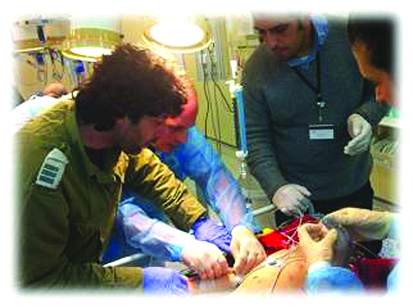
Solt worked with doctors in the vascular surgery and transplantation department to plan a procedure that most likely could not have been performed in Syria. Two balloons were inserted into the mother’s uterine arteries to prevent hemorrhaging. Next, obstetricians performed a C-section, delivering a baby who was transferred to an incubator in the neonatology department. Other doctors then sutured the mother’s uterus without complications.
During the first few days in the maternity ward, the baby fought off infections. Though the mother was extremely thankful for the medical care she received, she missed her family back in Syria. She said her husband, whom she had not heard from since she left for Israel, had no idea if she survived the operation. “Now my husband will have a wonderful surprise,” she said.

Sunday, February 11, 2018

Palestinians Enraged by Arab Journalists Visit to Israel

Israel’s hosting of Arab journalists is an “inexcusable and unjustified disgrace,” the Palestinians charged.  
Israel’s Ministry of Foreign Affairs last week hosted “special guests” from the Arab world in Jerusalem – a delegation of nine Moroccan, Lebanese, Syrian, Kurdish  and Yemeni journalists who came in order to “get to know Israel, its history and its society from up close,” the ministry said.
In response, the Palestinian Authority (PA) on Thursday denounced the journalists’ visit and called for their blacklisting.

The PA Ministry of Information called on the Arab Journalists Union to take “punitive and deterring measures” against the visitors and their media outlets, Times of Israel reported.
“Siding with Israel and its terrorism marks a departure from the Arab rank and the decisions of the Council of Arab Ministers of Information,” the PA ministry said, calling the visit an “inexcusable and unjustified disgrace.”

The visit, the statement added, “constitutes a departure from the official and popular Arab position that considers Israel a state of occupation, racism, ethnic cleansing, and extremism.”

Israeli MFA spokesman Emmanuel Nahshon tweeted in response: “Freedom of press Palestinian Authority style.”
“We will keep hosting journalists from all over the world and let them form their own impressions of Israel,” Nahshon pledged.

“We are proud to organize this visit of journalists from Arab countries to Israel, to help open a window on Israel and its people for readers across the Arab world,” MFA Director-General Yuval Rotem stated.

Seeking to expose the truth about the reality in Israel and the region, Israel periodically hosts journalists and opinion shapers from Arab and Muslim countries and enables them to experience the Jewish state in an unbiased and unfiltered fashion.

Timeline for Saturdays attack in Northern Israel


1.       the Iranians launched an attack drone into Israel, which the 
Israelis tracked and shot down  

2 the Israelis sent jets into Syria to hit the Iranian command center 
that had sent the drone, at the Tiyas Airbase in Syria . 

3 forces backing Bashar al-Assad fired off "dozens" of anti-aircraft 
missiles, including into Israeli territory, which forced Israeli 
communities to go into lockdown and the pilots of one F-16 
to abandon the jet.  

4 the Israelis sent eight jets into Syria to target a dozen Syrian and 
Iranian military facilities (lists and descriptions of the targets: 

 5   Assad forces fired off another 15-20 anti-aircraft missiles, again 
forcing Israeli communities to go into lockdown .

The drone was similar to the advanced American UAV seized by Iran - The drone emulated Western technology.  The structure and sophistication were similar to the American UAV Iran seized in 2011, including a "low signature" aimed at avoiding detection 

Monday, June 12, 2017

Palestinian Donates Recovery Room to Haifa Hospital


Tens of thousands of shekels donated to Rambam Hospital by Palestinian to improve treatment of childhood cancers and Israeli-Palestinian medical cooperation after he himself underwent treatment there; 'When I arrived at Rambam, I saw a medical team caring for patients, but I also saw the suffering of the sick children,' says donor.

Ilana Messika/TPS|Published:  11.06.17

A Palestinian man donated tens of thousands of shekels to the Rambam Health Care Campus in Haifa to improve treatment of childhood cancers and Israeli-Palestinian medical cooperation after he himself underwent cancer treatment at the Israeli hospital.

After being diagnosed with cancer, a senior Palestinian official was directed to Rambam for further medical examinations and treatment. While hospitalized in the Joseph Fishman Oncology Center, he met with several families of patients from the Palestinian Authority and Gaza, and showed a particular interest in the needs of hospitalized children, both Israeli and foreign. 


Photo: Rambam Hospital Spokesperson's Unit

“When I arrived at Rambam (Hospital), I saw a medical team caring for patients, but I also saw the suffering of the sick children,” recalled M. in a statement (Rambam Medical Center spokespeople said they were not at liberty to reveal the man’s identity). “Palestinian, Israeli, Syrian and children from other countries receive treatment in the hospital for a variety of serious illnesses and need all the help they can get. I decided to contribute as much as I could, both a humanitarian act and a symbol of solidarity.”

After completing treatment, M. underwrote the establishment of a children’s recovery room in the Institute of Radiology, inside the oncology center. The room provides a relaxing and supportive environment for children before and after chemotherapy and radiotherapy treatments, among others.

The oncology center opened its doors in June 2016, but due to lack of funding, patients still receive radiation therapy in a different building. This accessibly problem requires patients walking outside to get to the current location of Rambam’s radiation therapy equipment when moving them hinders their recovery.

Rambam estimates, that approximately 1,200 Palestinian children and adults from the Palestinian Authority and Gaza visit the hospital every year for cancer treatment.

“Israeli and Palestinian both societies suffer from the damage of violence and I am striving towards a situation where we can all contribute to peace and health,” continues M. “One where we can take care of children, save lives, share knowledge and train Palestinian doctors at Rambam Hospital.”

M. added his goal is to improve the state of health systems and treatment capacities within the Palestinian Authority and Gaza, and encourage more Palestinians to contribute to health promotion between the two peoples.

“Medicine is a bridge between people and I hope that owing to this donation and those which will come after, we will all live a better tomorrow,” M. concluded.


Wednesday, April 26, 2017

Israeli Clowns Cheer Up Syrian Refugees


In the video you’ll meet Israeli medical clowns - one Jewish and one Christian Arab - who bring relief and break down social barriers, one giant puffy red nose at a time.

Friday, September 30, 2016

Double Standards for Aleppo and Gaza

Make no mistake, the carnage taking place in Aleppo right now is a disgrace to the international community.
The Syrian government and Russian-backed forces are reportedly using chemical weapons, barrel bombs and increasingly powerful explosives to target innocent men, women and children. While rebel fighters have undoubtedly embedded themselves in the city in fortified positions, it appears that the civilian population is bearing the brunt of the conflict.
While there has been some condemnation from the UN, where are the protests on the streets of European capitals and where is the media frenzy about this disgrace? 
Had Israel been involved, or had the IDF aimed one solitary munition at Aleppo, I think the response would be much different.
The international community’s condemnation of the Assad regime and Putin’s Russia is nothing compared to the vitriol leveled against Israel for its far more restrained (and completely justified) 2014 operation against Hamas in Gaza.
Unfortunately for the 250,000 residents of Aleppo, the city is not being attacked by the IDF. There are no leaflets being dropped warning civilians to evacuate areas in the line of fire. There is no “roof knocking” — where non-explosive devices are dropped on the roofs of targeted buildings to give civilians time to flee. And judging by the number of civilian casualties and the extent of the destruction in Syria, there is very little to no concern for the well-being of innocent civilians.
Aleppo is a testament to the double standards at play when it comes to the treatment of Israel’s military operations. There is, however, a caveat. The IDF should be held to higher standards than the militaries of both Syria and Russia.
And that is why The Sunday Times of London caught my eye recently. One story was headlined “Putin’s gigantic firebombs torch Aleppo.” Next to it was an article entitled, “RAF drone crew divert missile to save ‘civilian’ seconds from death.”

The dissonance between the two stories is striking. On one side, we have the alleged deployment by Russia of a weapon “capable of blasting a massive ball of flame across wide areas of Aleppo.” On the other, the release of a video by Britain’s Royal Air Force showing a drone missile aimed at ISIS terrorists being diverted at the last minute to avoid killing a civilian.
One side was indiscriminately firebombing, while the other was deliberately acting to prevent civilian casualties.
The RAF evidently felt that its tale was a positive story, which showed that its drone squadrons act both ethically and in accordance with international law. Why is this news? Israel released many videos from incidents where missiles targeting Hamas terrorists were diverted due to the presence of Palestinian civilians. So why then were Israel’s identical efforts not deemed newsworthy?
Granted, the Sunday Times is a British newspaper covering the British military, but the UK press has never been shy about devoting many column inches to Israel and the Palestinians.

Israeli efforts to minimize civilian casualties go unreported or even ignored by the press, and Israel instead finds itself regularly judged in the court of public opinion, which is led by a lazy or hostile media.
So Israel is subjected not only to a different standard than the deplorable militaries of Syria and Russia, but even to a different standard than other Western militaries.
If and when the Syrian conflict comes to an end, will anyone be held to account for what certainly appear, at face value, to be genuine war crimes? Will there be a UN investigation and a Goldstone-style report? Will the International Criminal Court issue indictments? Given Russian involvement and the lack of American global power projection, it is unlikely that anyone will be held to account.
The next time open conflict between Israel and Hamas breaks out, will the parameters of judgment have changed as a result of the carnage in Aleppo and other parts of Syria? Or will Israel continue to be held to a standard of behavior unlike any other military in the world?
The likelihood is that nothing will have changed when it comes to how Israel is treated, and we will be left to conclude that, ultimately, the world will be outraged by Israel defending itself and its citizens irrespective of how ethically it behaves.
Simon Plosker is Managing Editor of HonestReporting


Monday, August 22, 2016

Syrian refugee creates website to thank Israelis

Israel has very quietly helping Syrian refugees long before the rest of the world were paying attention to the conflict's human disaster.   There were/are many projects such as setting medical hospital up north, opening the borders to treat injured Syrians.  Israeli children collecting jackets and blankets in the winters to clothes Syrian children.  They were concerned that Syrians parents may not use Israeli clothes because the cloths tags are in Hebrew so they tore out all the tags.  They did not give the clothes/blankest for acknowledgment but to make sure the Syrian children are warm in the winter.    Israel doesn't toot its own horn when it engages in humanitarian aid.  They simply do it out of sense of compassion and express Jewish values.

Now,  a Syrian refugee living in Turkey feels safe enough to begin sharing.  He has many hits from Arabs who cannot speak out in encouragement to speak for them too 

Sunday, June 26, 2016

Syrian Refugees vs. Palestinian "Refugees"

Of approx 500,000 Arabs who were ordered out of Israel prior by the Arab armys' invasion in 1948, very few indeed are alive today.

The rest are not refugees as defined by the UNHCR– in the entire rest of the world, no-one can pass on refugee status to their children, grandchildren and great-grandchildren.

It's time UNRWA was wound up. It has been the greatest fraud in human history.


Tuesday, October 6, 2015

Israel doctors nursed 2,000 Syrians


September 24, 2015 http://tinyurl.com/osg9grh 

A hospital in Safed has given much-needed medical treatment to around 550 Syrians – both fighters and children. Judith Field hears some of their stories…

 Thousands of Syrian refugees have fled the country, including injured fighters and children

Over the past two-and-a-half years, around 2,000 injured Syrian fighters and civilians have crossed the border into Israel and been admitted to Israeli hospitals. Most are men, but up to 17 percent are children.

Since the start of the civil war in Syria in 2011, 70 percent of the country’s medical community has been killed or fled and many healthcare facilities have been damaged or destroyed. Six- and-a-half million people have been displaced to neighbouring countries where they live in semi-permanent refugee camps with only basic hospital facilities.

The closest Israeli hospital to the Syrian border – around 40 minutes away in a fast ambulance – is the Ziv Medical Centre in Safed, a university 331-bedded hospital owned and funded by the government. It is the only hospital serving the 250,000 residents of the Upper Galilee and northern Golan Heights and has treated about 550 Syrians to date.
Learning to walk (Identities have been hidden for their safety)

“It all started one night in February 2013,” said Professor Anthony Luder, director of paediatrics. “An IDF ambulance pulled up at the emergency department and staff were astonished to see inside a group of injured Syrian fighters.”

Although the Israeli Defence Ministry described this as an isolated event in which Syrians were being treated as exceptional cases, more soon arrived and what started as a trickle of patients has become a steady flow. IDF patrols pick up the wounded at UN transfer points on the border on the Golan, or in places where the fence is absent or minimal. Staff at the hospital do not know where the patients come from, nor do they want to. “We’re doctors and they are our patients. All we want to do is to treat them,” said Professor Luder.

Patients might be suffering blast or shrapnel injury, gunshot wounds or a combination of these and other traumas. Treating such people, often with massive injuries, has its own challenges, not least of which is trying to work out what has happened.

“Only two have arrived with any sort of information: blood-stained notes pinned to their blankets. Often diagnosis involves guesswork,” he explained.

Some patients, while not injured, are still victims of the breakdown of the Syrian medical system. “A young girl was admitted with a massive ovarian tumour,” Professor Luder said. “We removed the tumour but the reality was that, if we sent her back to Syria, she would receive no treatment. So we kept her at Ziv for three months’ chemotherapy, and then sent her to a summer camp for Israeli children with cancer.” 
Patient with medical clown (Identities have been hidden for their safety)

It takes time for staff to gain the trust of the Syrian patients, and there is a language barrier, although the staff are of multiple ethnicities, matching the make-up of the local community: Jews, Muslims, Christians, Druze, Circassians and Bedouins. After a while, the patients begin to talk to the Arab and Arabic-speaking nurses. Many patients are terrified, having been told that Israelis are devils. One man, for example, refused to take his sheet off his face for a week.

The new head of the hospital held a meeting at which it was agreed more or less by all to continue treating Syrians. Staff felt they had a professional imperative to do so and that it might help build bridges. It would also develop their skills for use should they need to treat such severely injured Israeli people.

It has not always been easy for staff to balance the medical ethical obligation to treat Syrian patients with their personal feelings. Some thought: “If they can do that to each other, what could they do to us?” Others, though, felt a connection, saying that it reminded them of what Jews went through in the Holocaust. 

Many of the male patients deny they are fighters, but it is impossible to know. It would be good to be able to say that, following treatment, the fighters have a change of heart about Israel. This, however, is not the case – they might thank staff on leaving, but some still say they will be back to kill them.

Others, however, have a different attitude. Luder told me about a girl who was admitted with an amputated right leg and a shattered left leg. The local people donated a prosthetic limb. “She was discharged after eight weeks. Her mother expressed gratitude and a wish to meet again one day, when this troubled region is peaceful,” he recalled. Perhaps the children – some of whom have been born in Israeli hospitals – will share her attitude.
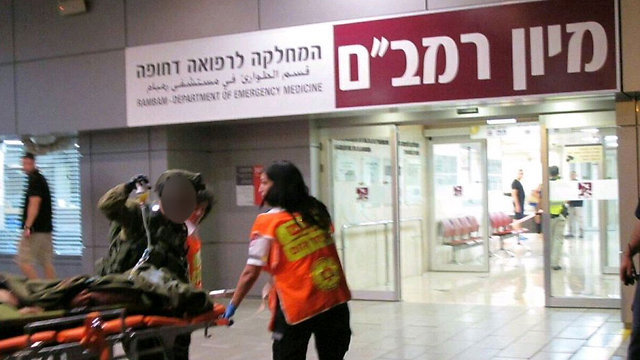
In military ambulance (Syrian patients treated in Israeli field hospitals.
 Identities have been hidden for their safety

Perhaps the seven-year-old boy who had been told, following 17 unsuccessful operations in Syria, that he would never walk again, will remember how he regained the use of his leg after one operation at Ziv.

Word has spread in Syria that people can access medical help over the border from people they consider the enemy and Syrians are filling up beds at Ziv. Syrian patients often stay in the hospital for months, longer than a local person would need, because usually there is no follow up treatment so rehabilitation must be started in the hospital.

They leave with a discharge letter in English and all trace of Hebrew and Israel removed from anything they take with them, often including expensive equipment that would normally be returned to the hospital.

The treatment of the local community is sometimes delayed and, naturally, people grumble. But they have also responded with generosity. Individuals and businesses have donated money and goods, for example clothes, toiletries, toys and reading material. Each child has a tablet computer to use while in hospital.

Treating the Syrians has cost the hospital $33million (£21m) to date. Although there is no clear answer as to where the funding will come from, Luder considers healthcare a humanitarian imperative. “Medicine has no borders. It can serve as a bridge between people. We will continue to provide life-saving treatment to the Syrian casualties for as long as it is needed.”