Showing posts with label Pillar of Defense. Show all posts

Tuesday, January 28, 2014

Rockets and tunnels: Hamas preparing for next conflict

If there is going to be a "Next" round, HAMAS is preparing its PR policy extensively with all its munitions in civilian areas against all international rules of warfare, see below

By Elior Levy
ynetnews.com Fri Jan 24 2014


From mosque tower cameras to a complex system of tunnels to a massive stockpile of long-range missiles, despite the relative quiet in Gaza and general attempts by Hamas to prevent an escalation, Hamas is hard at work preparing for its next war with Israel


The long period of relative quiet since Operation Pillar of Defense has been slowly dissolving into rocket fire, which reached its peak this week when the Islamic Jihad fired rockets at Ashkelon in the dead of night.

If not for the Iron Dome missile defense system, the results (both in Israel and in Gaza) would have been dramatically different. Like many times before, the background to the rocket attack was infighting between Hamas and the Islamic Jihad, and, like many times before, Israel paid the price.

In the meantime, Hamas is already preparing itself for the next round of fighting with Israel: Concealing long-range rocket launchers under residential buildings, building advanced underground tunnels costing around a million dollar each.

Hamas' security forces are already spread out along the main roads leading to the border fence with Israel, this time in an attempt to prevent further rocket fire at Israel. A well-informed source in Gaza said that Hamas has deployed hundreds of forces and has recently sent reinforcements.
Building in Kiryat Malachi damaged in Operation Pillar of Defense (Photo: Chabad Info)


Hamas training camp for youths (Photo: MCT)


Photo: AP
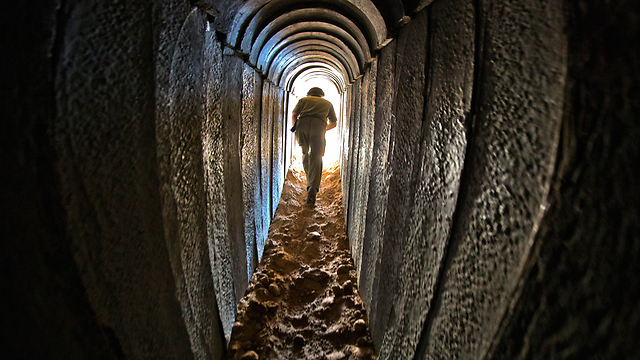
Photo: AP
Tunnel found near Kibbutz Ein Hashlosha (Photo: EPA)


Israel, for its part, has returned to its old policy of direct assassinations of rocket launchers, and thus, Ahmad Saad, the Islamic Jihad operative responsible for the rocket fire on Ashkelon, was seriously wounded after an IDF rocket hit him along a Gaza street.

Much the same way, the man responsible for launching rockets at Israel during Sharon's funeral found his death through a direct IAF attack.

Although Hamas is working to prevent any further rocket fire, it hasn't stopped them from maintaining somewhat of a revolving door policy in which terrorists from rival factions are arrested, taken in for questioning and then released after a short time.

Quiet or no quiet, Hamas is still licking its wounds and learning its lessons from the previous bout with Israel, all the while working to strengthen itself in anticipation of the next round.

Hamas has at its disposal an impressive cache of Gaza-produced M-75 rockets that can reach all the way to central Israel.

As part of its lessons from Operation Pillar of Defense, during which the IAF destroyed the majority of Fajr rocket launchers and the semi-submerged launch pits from which they were fired, Hamas decided to hide their launchers next to sensitive facilities that could serve Hamas in its public relations battle with Israel, creating a guise according to which Israel is attacking civilian infrastructure.

In addition, Hamas is hiding its rockets under multiple-story buildings and inside of them, sharing the space with its military wing. The group has set up cameras on the top of minarets and water towers in a bid to gather intelligence and also put Israel in a bind: Should Israel destroy a mosque, the image would probably make newspapers around the world.

But Hamas is also burrowing, building an impressive web of underground tunnels throughout the strip. The tunnels are supposed to hide Hamas' leadership and facilitate the speedy transfer of operatives during fighting.

The tunnels are currently being built and the sources in the strip believe that some of them will end under Israeli territory, like the tunnel found near Kibbutz Ein Hashlosha - which began near Khan Yunnis and popped up some 200 meters into Israel territory.

The effort being put into these tunnels is big both in terms of energy and money. Each one of these tunnels costs the terror government more than a million dollars.

Monday, January 21, 2013

"What I Saw In Gaza"


There are so many misconceptions about the real life in Israel. The influence of the media, the emotional outcries from the liberal lefties, the acceptance of statements that are not based on fact, the deligitimisation of Israel, etc.

It is therefore not surprising that when one who is exposed to this day by day comes to Israel to see for themselves the reality of life, they are amazed to find a different picture.

The story below is from one such lady in Arizona who not only came to Israel but actually joined the IDF (Israel Defense Forces). Her experience written below makes for interesting reading.

What I Saw During Operation Pillar of Defense

Four years ago, watching the coverage of Operation Cast Lead from the comfort of my dorm, I was a conflicted college student. As supportive as I was of Israel, I still found it painful any time I heard about civilian casualties in Gaza. What I saw portrayed in the media didn't add up: on the one hand I knew that the IDF was engaged in careful efforts to prevent civilian casualties, despite Hamas's strategy of fighting from amongst its own civilian population. Yet the media made it seem like the IDF was actively targeting civilians.

Back then, I understood Israel's efforts at protecting civilians as a something akin to a talking point -- I had no personal involvement in the conflict. Yet I had no idea how true it is until I myself participated in last week's Operation "Pillar of Defense" as an officer in the IDF.

When I moved to Israel and enlisted, I joined a unit called the Coordinator of Government Activities in the Territories (COGAT), which is devoted to civilian and humanitarian issues. 

As an International Liaison Officer in the Gaza office, my job primarily entails coordinating transfers of goods, aid, and delegations into Gaza. I work closely with representatives of the international community, and although our perspectives may differ, we maintain relationships of mutual respect born of a common goal; I am here to help them succeed in their work improving the quality of life in Gaza.

While the day-to-day work is challenging in Gaza, I learned over the past ten days that the true test comes with crisis. At exactly the point where most militaries would use the heat of war to throw out the rulebook, we worked harder than ever to provide assistance wherever and whenever possible. 

The eight days of Operation "Pillar of Defense" have been some of the hardest I have ever known physically and emotionally. The college student from Arizona would never have thought it possible to work 20 hours a day, fueled only by adrenaline and longing for just an hour of sleep on a shelter floor -- wearing the same filthy uniform because changing, much less showering, wouldn't allow me to get to a shelter in time when the next rocket barrage hit. And no, wearing the green uniform does not mean that you aren't afraid when the sirens sound.

Had you told me four years ago that there were IDF officers who stayed up all night under a hail of rockets, brainstorming ways to import medical supplies and food to the people of Gaza, I am not sure I would have believed you. But I can tell you it is true because I did it every night. 

What amazed me the most was the singular sense of purpose that drove everyone from the base commander to the lowest ranking soldier. We were all focused completely on our mission: to help our forces accomplish their goals without causing unnecessary harm to civilian lives or infrastructure. 

It is harder to explain the emotional roller-coaster -- how proud and relieved I felt every time a truck I coordinated entered Gaza, and how enraging it was when we had to shut down the crossing into Gaza after Hamas repeatedly targeted it. Or how invigorating it was help evacuate two injured Palestinians from the border area, only to be informed minutes later that a terrorist had detonated a bomb on a bus near my apartment in Tel Aviv.

So after all that I see and do, nothing frustrates me more than the numbers game that is played in the media. The world talks about "disproportionate" numbers of casualties as the measure of what is right and wrong -- as if not enough Israelis were killed by Hamas for the IDF to have the right to protect its own civilians from endless rocket attacks.
In my position, I see the surgical airstrikes, and spend many hours with the UN, ICRC, and NGO officers reviewing maps to help identify, and avoid, striking civilian sites. One of our pilots who saw a rocket aimed at Israel aborted his mission when he saw children nearby -- putting his own civilians at risk to save Gazans.

At the end of the day, what these "disproportionate numbers" show is how we in Israel protect our children with elaborate shelters and missile defense systems, whereas the terror groups in Gaza hide behind theirs, using them as human shields in order to win a cynical media war.

What's really behind the headlines and that picture on the front page? Every day, I coordinate goods with a young Gazan woman who works for an international aid organization. Last month we forged a bond when we had to run for cover together when Hamas targeted Kerem Shalom Crossing -- attacking the very aid provided to its own people. 

During the eight days of Operation "Pillar of Defense", not one passed without a phone call, just to check in. "Are you ok?" I would ask. "I heard they fired at your base. Please stay safe", she would reply. And every night I made her promise to call me if she needed anything. These are the things that the media fails to show the world, just as they underplay how Hamas deliberately endangers civilians on both sides of the border -- by firing indiscriminately at Israel from Gaza neighborhoods.

Maybe stories such as these make for less exciting headlines, but if they received more attention there would perhaps be more moral clarity, and thus more peace in the Middle East.

Sunday, December 16, 2012

Israeli, Gaza Cancer Patients Become Hanukkah Best Friends


Dec 12, 2012 By Itay Hod

A heartwarming Hanukkah tale of two teens fighting the same rare cancer, whose friendship transcends nationalist stereotypes.

On a sunny Sunday afternoon, pediatric oncology patients at the Tel Aviv Sourasky Medical Center gathered in the hospital’s auditorium for a big Hanukkah party. They lit the menorah and sang the traditional songs about the tiny Maccabean rebellion that defeated the mighty Greeks in 167 B.C.E.

But while the miracle of Hanukkah was being celebrated downstairs, a modern-day miracle was happening on the second floor. Tal Zilker, a 17-year-old cancer patient from Southern Israel, was chatting with his new best friend, Qsuy Imran (prounounced ‘Hussai’), a 17-year-old boy from Gaza.

Having just gone through a particularly aggressive round of chemo, Imran was too weak to join the festivities, and Zilker decided to forgo the first half of the party to keep him company.

“Chatting” may be stretching it a bit to describe the boys’ interaction. Zilker can say, “Are you in pain?” and, “When’s your next treatment?” in Arabic. Imran can manage “Do you have a fever?” and a few cuss words in Hebrew. But when you’re a teenager, vocabulary is nowhere near as important as being ambidextrous.

“We’re both Playstation fanatics,” said Zilker.

This friendship between two teenagers of the same age—who look alike, have the exact same type of cancer, and share the same love for video games—shouldn’t be all that surprising or newsworthy. But add their respective zip codes into the equation, and it becomes as fantastical a tale as a Tolkein novel.

Zilker is from Ashdod, a city in Southern Israel. Imran is from Khan Yunis, in Gaza. During the seven days of “Operation Pillar of Defense” last month, Hamas fired more than 1,400 rockets into Israel, most of them aimed at the Ashdod-Ashkelon area. The Israeli Defense Forces (IDF) struck more than 1,500 sites in the Gaza Strip, a tiny patch of land twice the size of Washington, D.C.

What’s more astounding is that while Hamas was launching those explosives, it continued sending patients to be treated in Israeli hospitals, many of them located in the same areas Hamas was targeting.

Israeli hospitals have been accepting Palestinian patients for years. There are simply not enough medical facilities in Gaza to treat its growing population. Those that are there are ill-equipped. According to the Palestinian Central Bureau of Statistics, there are 24 medical centers in Gaza, which serve 1.7 million people. Israel, in contrast, has 377 hospitals and a population of about 8 million. Last year alone, more than 100,000 Palestinians received medical care in Israel. Israeli hospitals continued to treat patients from Gaza even at the height of the fighting in November.

To make things even more complicated, many of the Israeli doctors who treat these patients are also soldiers in the IDF, in which service is mandatory. In fact, Dr. Dror Levin, the oncologist treating Zilker and Imran, spent the entire week of Operation Pillar of Defense patrolling the border with Gaza alongside the rest of his reserve platoon.

Though such contradictions might sound crazy to anyone else, here in the Middle East, it’s par for the course.

“It’s actually quite simple,” said Dr. Levin, now out of uniform. “Qsuy is not a representative of Gaza. All I see when I look at him is a boy who needs my help. That’s where it begins and that’s where it ends for me.”

Despite the bloody battle raging between their governments, Zilker and Imran seemed less concerned with geopolitics than with playing a game of virtual soccer, their favorite pastime.

The two met in May, when Zilker came in for his biopsy. An MRI done just days earlier revealed a tumor in his left knee. Imran was the first person he met at the oncology floor of the hospital.

They hit it off immediately.

Having gone through surgery to remove his osteosarcoma—an aggressive bone cancer—less than a week before, Imran was a “veteran” in hospital protocol. He quickly took Zilker under his wing and gave him the lowdown, carefully explaining what to expect should Zilker’s biopsy come back positive. (Imran’s father, who speaks Hebrew, translated for the boys, who also used a lot of pantomime.)

The fact that Imran had the same cancer that Zilker was suspected of having, in the exact same place, made their meeting—as they say in this corner of the globe—“bashert”: meant to be.

“At the time, we needed every bit of information,” said Anat, Zilker’s mother. “Qsuy was the only person we knew who had the same cancer. He became our lifeline.”

Imran’s father, Jihad, whose name incidentally means “holy war” in Arabic, became their unofficial guide through the difficult maze of doctors and treatments. “This terrible fate brought us together in a way that’s hard to explain,” said Anat.

Jihad says Anat has been a ray of hope for his family as well. Being a resident of Gaza, he and Imran are not allowed to leave the hospital except for a few organized trips. For the last 10 months, Anat has been bringing him and Imran home-cooked meals and clothes. Being so far away from his family and friends, he turned to Anat and her son for comfort.

“One of the only good things to come out of this is the fact that I found a new family,” said Jihad, referring to the Zilkers.

When the rockets began flying over Israel in November, Anat rushed to make sure the Imrans were OK. She was a bit worried at first about how the war would affect their newly formed friendship. “I wanted them to know it didn’t matter to us and that we loved them,” she said. “I knew it wasn’t their doing.

A self-proclaimed liberal, she says she never thought of them as anything but friends. But the experience has opened her eyes in one respect. “I knew Palestinians love their children. But I also knew that they were willing to send them on suicide missions. I guess I was surprised to see that they love their kids the same way we love ours. I look at Jihad’s dedication to Qsuy and it’s the same. No difference.”

Zilker wanted to know if Imran’s relatives were safe. “I asked him if any of the missiles hit his hometown. I felt bad.”

Asked whether he was worried at the time that their friendship might suffer, he said no. “We’re best friends.”

Imran wasn’t worried either. The only argument they’ve ever had is who’s better at PlayStation. They’re still fighting about that.

Jihad, who is a construction worker by trade, says he knew there were “good Israelis” from his days working in Israel before the blockade. But he was touched by the level of care he received during his stay in Tel Aviv. “They treated us like family. I have nothing but love for the doctors and staff and Anat and Tal, of course.”

Zilker summed it up perhaps the best, the way only a 17-year-old can. “I used to think that there were some good Palestinians but most of them were bad. Now I know that it’s the opposite. There are a few bad ones, but most of them are good.”

Both Zilker and Imran are getting ready to return home. In both cases, doctors were able to successfully remove their tumors. Imran says he’s looking forward to school, but the first thing he’ll do is dust off his soccer ball and hit the playground. Zilker is planning a trip to California.

They don’t know when or where they’ll be able to see each other next. But in the meantime, they plan on meeting on the virtual soccer field for their first ever post-cancer game, to settle the score once and for all.


Sunday, November 18, 2012

Medical Supplies in Gaza

Operation Pillar of Defense


Information Overview: Medical Supplies in Gaza

Background Overview:

The long standing shortage of medicines and medical supplies in Gaza stems primarily from a dysfunctional relationship between the Palestinian Ministries of Health in Gaza and Ramallah. The conflicts between the two offices have resulted not only in a shortage of medicines and supplies, but also in restricted access to medical treatments for patients outside of Gaza.

The Coordination and Liaison Administration to Gaza:

1. The CLA works to ensure that patients from Gaza have the access they need to get medical treatments.

2. Of the thousands of patients that requested permits to enter Israel for medical treatments, 99.3% were approved. Patients were only denied permits when it was determined that they could receive necessary treatment inside Gaza (Sept 2012).

3. From January to October 2012, more than 14,500 permits were issued by the Gaza CLA for patients and their chaperones to leave Gaza through the Erez Crossing.

4. All the requests for medical supplies (equipment and medicine) submitted by the international community to the Gaza CLA have been approved for entry into Gaza.

5. On average medical supply requests (medicines and light equipment) are approved within a span of 24-72 hours. Coordination of approved medical supplies is completed within one working day after the organization submits the intended day of import.

6. Since September 2012, international organizations, in coordination with the Gaza CLA, have impoted 32 trucks of drugs and medical supplies through Kerem Shalom Crossing. This has included spare parts for dialysis machines, helium for MRI machines, and three fully equipped ambulances. An additional five loads of medicine were imported into Gaza through the Erez Crossing through special coordination.

Shortages and Restricted Access:

1. The restricted medical supplies in Gaza are marked by a shortage of 400-500 varieties of medical equipment (out of a defined 700), including a shortage of surgical and anesthetic equipment.

2. There is an average shortage of 33% of desired types of drugs at any given time.

3. According to the World Health Organization, the process of referrals for patients from Gaza to receive treatment in Israel, the West Bank, and Jordan was suspended for nearly 10 days due to disagreements between the Ramallah and Gaza Health Ministries. As a result, a 38% reduction in monthly referrals left several hundred patients without necessary treatment.

4. The WHO reports that due to the failure of the Palestinian Ministry of Health to pay its accruing debts to Jordan, Jordanian hospitals refused to accept government referrals of patients from Gaza.

5. Medical suppliers are often reluctant to sell supplies to Gaza since there are issues with non-payment.

Operation Pillar of Defense:

1. Gaza hospitals are reported to be at 80% capacity, only slightly higher than intake then during routine periods.

2. On November 17th, the Coordinator of Government Activities in the Territories updated Hassin el Alshich that, despite the problematic security situation and the ongoing rocket fire, it would be possible to transfer medical supplies into Gaza.

3. Tomorrow morning, 18 November 2012, 10 Red Cross trucks with medical supplies and one UNRWA truck are scheduled to enter Gaza via Kerem Shalom Crossing. Two trucks have been designated as being of particular importance as they are carrying much needed anesthetics and bandages.

4. Since the start of the operation there have been two reported incidents of light damage to medical facilities due to shocks from Israeli air strikes on terrorist infrastructure in the vicinity.

a. Light damage to windows and doors of the Al-Quds hospital and the nearby Palestinian Red Crescent station in the Gaza district. Two Al Quds workers also sustained light injuries.

b. Light damage to windows in the Al-Karma hospital in the Jabaliya District.