Wednesday, May 30, 2018

Another "Unique" Tunnel Destroyed

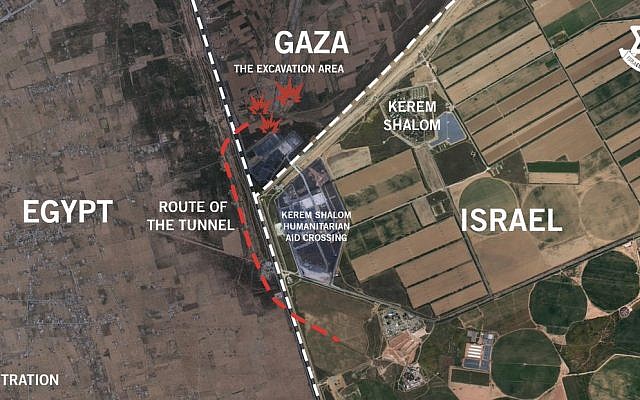
The Israeli army on Tuesday afternoon struck what it said was a Hamas tunnel in the Gaza Strip that extended hundreds of meters into Egyptian and Israeli territory.


Note path of tunnel on red dotted line, bypassing the Gaza Israel border

The IDF said the U-shaped attack tunnel destroyed near Rafah and the Kerem Shalom border crossing was still under construction and not yet usable.

The military said the tunnel crossed from Gaza into Egypt and from there into southern Israel, and was intended both for smuggling weapons and for attacks against Israel.
Its full length was around 2 kilometers (1.2 miles), the army said, and the segment inside Israeli territory was 900 meters (half a mile) long.
The army called the tunnel “unique.”
“This is a very long tunnel,” a source told the Ynet news site. “It also had exit shafts on the Egyptian side. The tunnel was dealt with using airstrikes [in Gaza], and in the coming hours will also be taken care of on our side to neutralize it entirely.”

Israeli officials reportedly informed Egyptian counterparts of the planned strike on the tunnel, according to Hebrew-language media. It was not clear if Israeli strikes on the tunnel included action over the border in Egypt.

Tuesday, May 29, 2018

Biting the Hand that Feeds You


Despite Hamas’ repeated assault on the Kerem Shalom border crossing, the only lifeline that supplies basic goods to civilians in Gaza, Israel has been battling intensively to keep it open.
The episode underlines a much wider phenomenon in which Hamas seeks to create a crisis in order to bring in outside funding for Gaza’s needs, so it can ensure the stability of its regime and keep supporting its military wing.
Meanwhile, the Palestinian Authority seeks to choke off Gaza’s economy to punish Hamas for refusing to disarm its military wing and force it to pay a price for splitting off from the PA.
However, those paying the price for this are the residents of the Gaza Strip.
Three times this month, Kerem Shalom was attacked by mobs acting under Hamas instructions. Rioters destroyed fuel pipes that carry critical energy supplies and looted the Palestinian side of the crossing terminal.
According to Israeli intelligence assessments, these actions are part of a wider effort by Hamas to ramp up the pressure on Israel and the international community in order to obtain fresh funds for the collapsing Palestinian economy. The deadly border incidents orchestrated by Hamas this month are part of the same effort. Hamas wants someone else to foot the bill for the civilian economy so it can rescue its regime from collapse.
Gaza’s power plant, for example, runs on gas, and can supply 150 megawatts of electricity per month. Yet on April 12, Hamas shut the power plant down completely, cutting off energy supplies to two million Gazans. Throughout this time, gas was flowing freely into Gaza from Israel. Despite the daily power cuts to Gaza’s civilians, Hamas’ tunnels continued to receive power. It is safe to assume that Hamas’ rocket factories also continued to work.
Israel is, in fact, the only country that has been fighting to keep Gaza supplied with electricity. Egyptian power lines can deliver 30 megawatts, but have been shut down by Egyptian authorities for the past four months.
As part of its conflict with Hamas, the PA reduced payments for electricity. Israel quietly pressured it to reverse this decision, and the PA did so.
Similarly, at Kerem Shalom, Israel is working around the clock to keep the crossing open and functional, despite Hamas’ own attacks on it.
Thanks to these efforts, diesel fuel and gas tankers have recently resumed the transfer of critical energy supplies to the Gaza Strip, averting a certain fuel crisis.

Monday, May 28, 2018

Relax away from the Summer Heat


Time to relax and get away from the summer heat!!

Arab Muslim Woman Defends Israel


Mrs. Dema Taya, touring America with "Arabs
Breaking the Silence" contradicts anti-Israel antagonists: 'Muslim women's lives in Israel are
modern and good- and that's a reason why the Muslim world lies to destroy Israeli culture of freedom and self-determination.

Thursday, May 24, 2018

Another Week in Israel's History

A guest post from Harris Zvi Green http://blogs.timesofisrael.com/another-week-in-israels-history/ 


The world is up in arms (over the 62 Gazans killed). Human Rights forums – the same forums currently taking a rain-check on the Syrian genocide – are beside themselves. Erdogan is threatening anything that moves. South Africa recalled her ambassador for consultations. The Europeans are demanding explanations. The media is castigating Israel for using “disproportionate means” to defend its territorial integrity and the armchair experts are insisting that Israel must certainly have some magic technology to protect her borders from those wishing to murder its citizens. Everybody who has something to say is saying it. Nobody wants to be left out. 
Neither do I.  So let’s consider the facts.
• In 2005 Israel unilaterally withdrew its armed forces and civilian presence from Gaza and returned to the pre-1967 internationally recognized border.
• The territory – supposedly a part of the proposed two state solution – is governed by Hamas, an acknowledged and accomplished terror organization with a track record to prove it.
• Since achieving its “independence”, Gaza has initiated three major military confrontations with Israel. Even during the relatively peaceful interludes between these confrontations, thousands of rockets fired from Gaza continued to rain down on civilian targets in Southern Israel.
• In order to limit the free flow of arms from Iran to Gaza, Israel and Egypt imposed a naval blockade on Gaza. This blockade was deemed legal by the UN appointed Palmer Commission. In the words of the Commission: “Israel faces a real threat to its security from militant groups in Gaza. The naval blockade was imposed as a legitimate security measure in order to prevent weapons from entering Gaza by sea and its implementation complied with the requirements of international law.”
• Gaza is apparently threatened with a humanitarian crisis. Nonetheless, its rulers have accumulated an impressive arsenal of missiles and invested millions of dollars to create an infrastructure of terror tunnels to enable commando attacks on civilian neighborhoods inside Israel.
• Hamas continues to hold two Israeli citizens hostage and the bodies of two Israeli servicemen killed in action in 2014.
• Earlier in the week, Hamas militants destroyed the power supply lines from Israel to Gaza.
• This is only some of what we Israelis have had to live with for the past 13 years and no, there doesn’t appear to be any realistic prospect for positive change.
Now let’s consider what Israel has done to counter this horrific state of affairs.
• Israel developed the Iron Dome air defense system to intercept the barrage of missiles being fired at civilian targets in Israel.
• Israel is currently constructing an underground security obstacle on its sovereign territory to effectively thwart the threat of terror tunnels on its civilian population.
• In an attempt to provide basic services to the Gaza’s civilian population, Israel provides both power and water to Gaza.
• Thousands of trucks transport food and medical supplies on a daily basis to Gaza.
• The accumulated debt of the Palestinian Authority in respect of these services is enormous. You’ve got it. My tax dollars are financing those seeking to kill me.
Now let’s consider what Israel hasn’t done.
• Israel hasn’t developed an effective technology to prevent destruction of certain of her security infrastructures.
• Israel hasn’t developed an effective technology to prevent the hostile infiltration of its borders.
If Israel had such technologies, she would certainly have used them. Had Israel’s objective been to massacre as many Gazans as possible, 62 casualties out of a target of 40,000 should be considered a dismal failure.
I know this is difficult to comprehend because Israeli technology is at the source of everything that opens and closes. From military innovations to cyber security, from medical technologies to life-saving pharmaceuticals, from communications to driverless vehicles, from wastewater recycling to water desalinization. You name it. Israel’s done it.
When other countries are confronted with security issues like these, they traditionally solve them by, for want of a better phrase, knocking the shit out of those wanting to harm their citizens. They wouldn’t waste time and effort developing technologies to minimize the loss of enemy lives.
Imagine if Israel reacted like other countries do. Imagine if Israel reacted like the Russians did in Ukraine, or like they did in Ossetia and Abkhazia, or in Afghanistan or in Chechnya. Imagine if Israel reacted like the Turks did in Kurdish Syria or in Armenia. Or like the Belgians did in the Congo, or like the French did in Algeria. And so the list goes on and on and on and on.
So in light of the above, let’s consider what happened last week:
• 40,000 Gazans demonstrated violently on Israel’s border in an attempt to destroy the security obstacles designed to protect Israeli civilians. In true Hamas tradition, their leaders led from behind while their women and children provided cover for their soldiers who focused on achieving the military objectives of the demonstration.
• In the absence of an effective technology to protect Israel’s territorial integrity, Israel’s Defense Forces killed 62 people – 53 of them Hamas or Islamic Jihad militants. That’s surgical by any standard.
• Not a single Gazan who went about his daily routine by going to work or to school was killed.
And so dear members of the UN Human Rights Council, Emperor Erdogan, President Ramaphosa, Ms. Federica Mogherini, esteemed members of the Press and all the armchair experts of this world, I must tell you that I’m proud of my country and the concern it shows for human life.
I salute Israel’s leadership and her defense forces. They risk their lives on a daily basis to ensure my safety. I salute the military ethic of the officers and the soldiers of Israel’s Defense Forces. I salute the resolve of my country to continue developing technologies for the benefit of all mankind despite our precarious security situation and the hostility and hatred displayed by our neighbors.
Wednesday, May 23, 2018

A Dream Comes True


Omer will never forget the day his dream came true. Despite his physical disabilities, Omer joined the Nes Tziona Sektzia soccer team for the field practice that guaranteed the team’s moving up to the National League.
13-year-old Omer has cognitive developmental disabilities and lives at ALEH Moriah in Gedera along with other residents with various disabilities. As part of his regular schedule, Omer participates in therapeutic rehabilitation and attends ALEH’s on-premises special education school.
This year, ALEH’s incredibly dedicated National Service volunteers initiated a new program at ALEH Moriah in Gedera: Making Dreams Come True, in which they realize a dream for each resident, according to his/her area of interest. Omer loves to play soccer and can even kick a ball like a professional, so it was only natural that Omer’s dream was to play with professionals.
ALEH Moriah’s resourceful National Service girls didn’t hesitate. They contacted social activist Sivan Avishag Levy who in turn got in touch with Avi Ludrick, owner of the engineering firm A. Ludrick. In the past, Avi administered the Maccabi Shearim soccer team and he still has plenty of contacts with movers and shakers in the sports’ world, which made it easy for him to contact the Sektzia administration. CEO Ronen Zeigerman and owner Eli Cohen immediately raised the gauntlet, agreeing to make Omer’s dream come true.
On April 22, the entire Nes Tziona team waited for Omer, presenting him with a team shirt when he arrived and a soccer ball signed by the each of the players. Team members then invited Omer to the field, warmly including him in their practice as a team regular. After practice, fellow team members presented Omer with a chocolate soccer ball, cake and candy. Omer enjoyed a unique day of fun, running on the open field, loving the huge expanse and the numerous balls rolling around in every direction.

According to Avi Ludrick, having Omer join the team was a great privilege. “The wonderful privilege of making a dream come true came our way. When you do things based on giving and love, wonderful things happen. As far as I’m concerned, this was a special mission, over and above making a dream come true for a boy who would never be able to achieve this in his day-to-day life. I think that we have to publicize this and show the entire country how much the organization (ALEH) gives to residents with disabilities, enabling them to experience life and live like everyone else.”
Naama Sudkovitz, director of ALEH Moriah in Gedera added, “We were extremely excited to see how Avi and Sivan and the entire Nes Tziona team got together for the benefit of our special resident. The special light of people with disabilities, and the understanding that they are an integral part of society will bring significant social change to the State of Israel, in the way people relate to people with disabilities and accept the other within society.”

Tuesday, May 22, 2018

New Passenger Wing Opens At Ben-Gurion Airport As Air Travel Booms


Max Schindler  February 16, 2018

The new passenger wing includes telescopic glass pathways, eight plane exit gates, four bus exit gates, along with shops, restaurants, a VIP lounge and maintenance and cargo services.

Ben-Gurion Airport opened the fourth passenger wing in its main terminal on Thursday, a sign that Israeli air travel continues to expand amid a growing economy and calmer security.

The new extension in Terminal 3, Wing E, will accommodate up to 1,800 more passengers per hour, allowing for dozens of additional incoming and outgoing flights daily. That should reduce the load on the other congested wings and improve service provided for passengers.
Wing E was designed by Israeli star architect Moshe Safdie and assisted by architect Irit Kochavi.

“As part of a fruitful cooperation with the Israel Airports Authority, the fourth wing that my office was responsible for designing will enable the expansion of the capacity of those departing and entering Israel, thus further opening the field of tourism in Israel,” Safdie said. “I hope that work on a fifth wing will begin shortly.”

The new passenger wing includes telescopic glass pathways, eight plane exit gates, four bus exit gates, along with shops, restaurants, a VIP lounge and maintenance and cargo services. Some of the gates include double bridges, allowing for passengers to board and disembark from both the front and back of wide-bodied aircraft.

Ben-Gurion handles more than 90% of passengers entering and exiting the Jewish state, and travel through the congested airport continues to rise.

Almost 20.8 million passengers transited through Ben-Gurion in 2017, according to data from the Israel Aviation Authority, a sharp uptick from 17.9 million in 2016. The airport’s 2018 estimate is 23 million.

When Ben-Gurion sees more than 25 million passengers transit through the site, that will result in the airport being classified as among the world’s largest airports, Globes reported. That is projected to occur in 2019, barring a major security incident.

The rapid uptick in passengers takes place despite the negligible number of transit passengers. Flagship airliner El Al has not adopted a transit-friendly business model for security reasons, putting it at a competitive disadvantage to airliners like Turkish Airlines, which has turned its Istanbul hub into a major transit hub.

More than 100 airliners now service the airport, a handful of which have launched operations in the past year. The increase in competition comes after Israel signed the Open Skies agreement a decade ago, permitting many more European airliners to fly to Tel Aviv.

The airport is in the middle of a multi-year expansion plan, with recent renovations to Terminal 1, which services domestic locales, along with hosting low-cost airliners like Wizz Air, Easyjet and Ryanair.

The relatively strong local currency – with a dollar trading for NIS 3.53 at Thursday evening – has made shekel-priced flights cheaper for Israelis, along with low oil prices and more intense competition.

In 2017 a record-breaking 3.6 million tourists visited Israel, but it took three years since the Gaza war – Operation Protective Edge – for the tourism numbers to bounce back to their regular growth rate.