Saturday, February 9, 2019

Amnesty International has lost its moral way


Alex Ryvchin 31 January 2019

Amnesty International has unveiled a new campaign to pressure digital tourism companies such as Booking.com, Expedia, Airbnb and TripAdvisor to delist properties held by Israelis living in the West Bank, and calling on governments to pass legislation that would result in the total boycott of those living in Israeli communities in Judea and Samaria .

It is just the latest attack in a long war waged by Amnesty and other once-respectable human rights organisations intent on turning public opinion against Israel and bringing about its economic and political isolation.
The origins of this lie in an infamous non-governmental organisations forum of the UN World Conference against Racism held in Durban, South Africa, in September 2001. The conference lives long in the memory for the appalling racism that marred an event convened for the very purpose of combating such conduct. Posters displayed Jewish caricatures and Nazi icons, and participants circulated copies of the anti-Semitic fabrication, Protocols of the Elders of Zion. US congressman Tom Lantos called it “the most sickening display of hate for Jews since the Nazi period”. The UN’s human rights commissioner, Mary Robinson, told the BBC “there was a horrible anti-Semitism present”.
In 2002, following an Israeli military operation in the West Bank city of Jenin in response to the Passover massacre in Netanya, in which a Palestinian suicide bomber murdered 30 civilians during a celebratory feast, Amnesty accused Israel of carrying out war crimes and massacres of Palestinian civilians. The allegations, promptly reported by the BBC and other news outlets, placed the Palestinian civilian death toll at more than 500. But 52 Palestinians died, the majority of them combatants, along with 23 Israeli soldiers, in fierce urban combat.
False allegations of a massacre made by Amnesty lubricated the machinery of the political campaign against Israel, leading to street protests, campus hearings, reams of condemnations and anti-Israel resolutions across civil society and government.
In 2015, Amnesty was forced into a humiliating admission that it had lobbied the Australian government to accept murderous Lindt Cafe terrorist Man Haron Monis as a genuine refugee.
Last April, Amnesty’s secretary-general called Israel’s democratically elected government “rogue”. In 2010, the head of its Finnish branch called Israel a “scum state”. Its British campaign manager has likened Israel to Islamic State and been condemned for his attacks on Jewish parliamentarians.
Perhaps as revealing as Amnesty’s fixation on Jews living on the “wrong” side of a long-defunct armistice line has been its relative silence on the disturbing trend of rising anti-Semitism. In April 2015, Amnesty UK rejected an initiative to “campaign against anti-semitism in the UK”, as well as “lobby the UK government to tackle the rise in anti-Semitic attacks in Britain” and “monitor anti-Semitism closely”. It was the only proposed resolution at the annual general meeting that was not adopted.
The skewed morality revealed by Amnesty’s obsession with Israel reflects a broader decline in the non-governmental sector. Whereas groups such as Amnesty and Human Rights Watch once led the struggle against Soviet tyranny and actively defended the rights of political prisoners, today they serve an increasingly narrow political agenda, one aligned with anti-Western, anti-capitalist forces. Amnesty’s apparent contempt for Israel, its ho-hum attitude to anti-Semitism, and its inordinate condemnations of democracies all stem from this malaise.
Of course, the settlements are a point of conflict between Israelis and Palestinians. Indeed, the parties identified settlements as a final status issue in the historic Oslo Accords signed between the Palestine Liberation Organisation and Israel in 1993. It was agreed that the questions of which settlements will be annexed to Israel and which will be dismantled or transferred to Palestinian sovereignty are to be resolved in direct negotiations in the context of a final peace agreement. But the pursuit of peace is not aided by Amnesty’s political manoeuvres and attempts to isolate Israel, which perpetuate conflict by other means.

Wednesday, February 6, 2019

LATRUN - II

(Guest post by Gloria of Grandma's Army)
One of the fiercest and most crucial battles of the War of Independence was the fight for the fortress of Latrun, which commands the main road between Tel Aviv and Jerusalem. This series of engagements is important in its own right, and also because some who fought there went on to become important figures. Two would even rise to the office of prime minister: Yitzhak Rabin and Ariel Sharon. The fortress at Latrun, and the nearby Trappist monastery overlook the scenic Ayalon Valley, about 16 kilometers west of Jerusalem
Its commanding location along an ancient route gives it great strategic value, making it the site of many battles, going back to biblical times. Here, Joshua prayed for God to make the sun stand still so he could finish defeating the Amorites (Joshua 10:12-13). In 167 BCE the Ayalon Valley was where Judah the Maccabi won an important victory over the Seleucids. The Templars built a fortress there in 1187.
 In the late 1930s in Mandatory Palestine, there were a series of riots by Arab residents against the Jewish community and British rule. Because of this, the British army built a series of "Taggart" forts, named for the engineer who designed them, which were essentially fortified police stations at strategic points. Latrun was a natural site for a Taggart fort due to its view of the main Tel Aviv-Jerusalem highway. But as the British garrison left Latrun on May 14, 1948, the Arab Legion of Transjordan moved in, initiating one of the darkest hours for the new Jewish state.
The Arab Legion used this location to deny Jewish access to Jerusalem, and its 100,000 Jewish residents began to starve. Driving along this route today, one can see the carefully preserved remains of the crudely armored trucks that were destroyed trying to break the blockade nearly 60 years ago. Prime Minister David Ben-Gurion believed that the loss of Jerusalem would be fatal to the newly established state, so he made a risky decision to commit scarce military resources to the taking of Latrun.
Many of the Israeli soldiers were Holocaust survivors conscripted soon after arriving in Israel. Their high casualty rate remains a point of controversy to this day. At the time, the army was sadly lacking in manpower and equipment. The following is a first-hand account written by Ariel Sharon:
“My platoon and I are lazing in an olive grove, passing the heat of the day, thinking pre-battle thoughts, blending with the water-smoothed stones and the earth, feeling part and parcel of the land: a rooted feeling, a feeling of a homeland, of belonging, of ownership. 
Suddenly, a convoy of trucks stopped next to us and unloaded new, foreign-looking recruits. They looked slightly pale, and were wearing sleeveless sweaters, gray pants, and striped shirts. A stream of languages filled the air, names like Herschel and Yazek, Jan and Maitek were thrown around. They stuck out against the backdrop of olives, rocks, and yellowing grains. They’d come to us through blocked borders, from Europe’s death camps. I watched them. Watched them strip, watched their white bodies. They tried to find fitting uniforms, and fought the straps on their battle jackets as their new commanders helped them get suited up. They did this in silence, as though they had made their peace with fate. Not one of them cried out: ‘Let us at least breathe the free air after the years of terrible suffering.’ It is as if they’d come to the conclusion that this is one final battle for the future of the Jewish People.”
Despite the fact that the attacks failed to drive out the Arab Legionnaires, they did prevent the Jordanians from leaving the fortress. This bought the Jews the time and space they needed to carve out an alternative route to the south, called the "Burma Road",  that lifted the siege of Jerusalem.

While in the area, visitors can also tour Mini-Israel, an outdoor theme park which features all of the country's most famous landmarks in 1:25 scale. And/or take their children to #Mini-Merkavot Latrun, where they can enjoy pony rides and a tractor tour of the entire Ayalon Valley.

Tuesday, January 29, 2019

Sorry dear reader, but the writing is on the wall


Mark Lewis JAN 29, 2019, 


When I was five, a Roman Catholic school teacher intervened in a squabble between me and her son, calling out, “It’s a shame Hitler didn’t finish you all off.” Only 27 years had passed since the end of the Second World War.

There were odd episodes of antisemitism – a swastika painted on my garage door by the far-right National Front, verbal abuse by Pakistani teens  who yelled “death to Yahud [Arabic for ‘Jews’]” as I entered synagogue and the odd barbed comment from teachers and pupils – but we were British Jews and beat off such occurrences. There were many more episodes of grassroots antisemitism; In this politically incorrect era, antisemitism was accepted.

As teens, we campaigned for the release of Soviet Jewry so refuseniks could flee to Israel. “Anatoly” Sharansky needed Israel, while  I merely needed it to be there, just in case – but Britain hadn’t killed Jews for 800 years.

I can’t put my finger on when leftist antisemitism emerged as a force of Jew-hatred on par with far-right and Islamic antisemitism. Initially, Labour was good for the Jews. It stood up for the underdog. But the perception of Jews as the underdog changed as that of Israel as the underdog changed. Its successful rescue mission in Entebbe and the election of the first Likud prime minister conveyed to many the image of a tougher Jewish state. British Jews were now seen as the capitalist oppressors, with dual loyalties.

A change in the Labour Party’s electoral system led to Jeremy Corbyn’s election, and the explosion of social media  brought on the widespread dissemination of Nazi-era antisemitic propaganda reminiscent of Goebbels. Attempts to challenge Jew-hatred were dismissed as smears . The relatively few complaints that were upheld led to a revolving door of suspensions so those expelled were soon brought back on board.

Worse, this brand of antisemitism was mainstream in the Labour Party membership and reflected Corbyn’s leadership. Daily, there’d be another revelation about Corbyn. Photos of him laying a wreath on the graves of terrorists who murdered Olympic athletes were dismissed. He defended a mural showing hooked-nose bankers playing Monopoly on the backs of workers, only later acknowledging its  antisemitic theme, but saying he hadn’t noticed its bigotry.

Corbyn will tell you “there is not an antisemitic bone in [his] body,” and that he is “against all racism”. Yet there are still daily revelations of antisemitism and the abusers torment those who speak out, including TV presenter Rachel Riley and comedian Stephen Fry.

And support for Labour grows when the opposite should be expected. Nearly 40 percent of voters continue to support the party that admits to its antisemitism problem. Many in the British Jewish community say they will leave if Corbyn becomes prime minister. It is too late. He has moved the rock and the antisemites have crawled out. They are not going back.

I’m sure there are those who think my pessimism premature, but why wait? There may not be pogroms, but life will be uncomfortable for Jews. No shechita (animal welfare grounds), no brit milah until 18 (let the child decide), no dual nationality, no visits from Israelis (belligerent).  So Britain is the new Anatevka. It’s time to wander. Only this time there is somewhere to go.


Wednesday, January 23, 2019

BDS Counter-Productive To Peace


The former president of South Africa, Nelson Mandela, once said, “If you want to make peace with your enemy, you have to work with your enemy. Then he becomes your partner.”

Yehuda Cohen, CEO of Lipskin Company, located in the Barkan Industrial Park, recited those words on Wednesday at the Jerusalem Post Diplomatic Conference. Speaking on a panel titled, “Coexistence in Conflict: How BDS Undermines the Chance for Peace,” Cohen explained that he employs 100 people in his West Bank plastic factory – 70 Palestinians and 30 Israelis.

“I give my Palestinian workers hope that can build their homes, hope they can send their children to university, hope they can live a normal life,” said Cohen, noting that these employees make higher salaries in Israel than in the Palestinian territories. His factory, he added, “is a bridge for peace.”

“If BDS or any kind of labeling or boycott is successful, we can say we lost the option to live in this area,” said Cohen. “I believe that work brings hope and boycott brings suffering.”

Minister of Strategic Affairs Gilad Erdan reflected on Airbnb’s decision in an earlier speech at the conference, calling it “appalling in its hypocrisy, outrageous in its discrimination, and counter-productive in its effects.”

“This policy of distinguishing or differentiating between Israel and Judea and Samaria is discriminatory, counter-productive and simply dangerous,” he said. “This policy is counter-productive becomes it aims to undermine the very activities that can form the basis for a viable peace.”

The best model for Israeli-Palestinian coexistence can be found in industrial areas in Judea and Samaria, Erdan said. Here, Israelis and Palestinians, Jews, Muslims, Christians and Druze all work together in mutual respect and harmony, yet these areas are a main target of the policy that calls to distinguish between Israel, and Judea and Samaria.

“Nothing could be more counter-productive to peace,” he said.

This was true in October 2015, when some 500 Palestinians lost their jobs when the SodaStream headquarters moved from its location in Mishor Adumim industrial park in the West Bank to a new facility in Lehavim, within the Green Line, due to pressure from the BDS movement.

“There was no great elation for the BDS movement because it quickly discovered that hundreds of Palestinians lost their jobs,” said Efrat Mayor Oded Ravivi, who also spoke on the panel. Ravivi said what BDS supporters don’t understand is that its outcome is worse for the Palestinians.

“For us [the Israelis] it might be unpleasant, but we are way stronger and more financially stable,” he said.

He added that BDS supporters are out of touch with the reality in Judea and Samaria, since many choose not to visit. He cited the popular Rami Levy grocery store that is in the center of the Gush Etzion junction, where “Jews and Arabs are walking up and down the same aisles.” He said it is the chain’s most profitable branch.

To help showcase this co-existence and the unique products being farmed and created in Judea and Samaria by Jews and Arabs alike, the Ministry of Strategic Affairs hosted a display table at the conference. Diplomats could touch and taste West Bank products and talk with representatives from the area.

Special emphasis is placed on the innovative solutions to agricultural challenges that serve both communities and the day-to-day peaceful coexistence that working together fosters.

“While we work to counter the lies and pressure of the boycott organizations, we’re also working to spread the truth about Israel and support those harmed by the boycotts,” Erdan said.

A Palestinian businessman, Ashraf Jaabari, also spoke on the panel. He told listeners about the recent launch of the Judea and Samaria Chamber of Commerce and Industry, where both Israelis and Palestinians can participate.
“I believe if we continue to work hard, we will get to excellent results,” Jaabari said.

But Ron Brummer, director of operations at the Ministry of Strategic Affairs, said while working to combat BDS, it is also important to label it for what it is – antisemitism.

Brummer said that according to the International Holocaust Remembrance Alliance, signaling out Israel is defined as antisemitism.

He then compared the BDS movement to a load of dirty laundry.

“You throw in antisemitism, terrorism, and delegitimization. The washing machine works and out comes a message of human rights, justice and equality,” Brummer said. “You cannot talk about annihilating the State of Israel. So, BDS is used to cover up the movement’s true face: antisemitism [which is] linked to terror and denying the mere existence of the State of Israel.”

Brummer added that BDS is a tool being used by those who want to delegitimize Israel. He said there is no threat that BDS will cause the Israeli economy to collapse. Rather, it “eats at the hearts and minds of the uneducated, of people who don’t know the reality of this area.”

Brummer, however, said to attending diplomats: “You have to realize that any victory for BDS is a defeat of coexistence.”

Tuesday, January 15, 2019

The UN, the "State of Palestine" and the Torture of Women

by Khaled Abu Toameh  •  January 15, 2019 at 5:00 am
  • This is the kind of story that the "State of Palestine" does not intend to raise during its chairmanship of the largest bloc of developing countries at the UN. It seems that, from the point of view of the Palestinian Authority leadership, Jbara's ordeal does not fall within the category of human rights.
  • Jbara's story has barely attracted the attention of the international mainstream media. As far as many foreign journalists covering the Middle East are concerned, a Palestinian woman complaining about torture in a Palestinian prison is not newsworthy. Had she been detained by Israel, Jbara would have most likely made it to the front pages of the world's leading newspapers and magazines in a matter of minutes.
  • The PA regularly complains about human rights violations of Palestinians held in Israeli prison for security-related offenses. But when the PA's own security forces detain and torture a mother of three, Palestinian leaders are found elsewhere -- like at the helm of a UN bloc.
The Palestinian Authority's recent arrest and torture of a Palestinian 
mother of three is the kind of story that the "State of Palestine" does not intend 
to raise during its chairmanship of the largest bloc of developing countries 
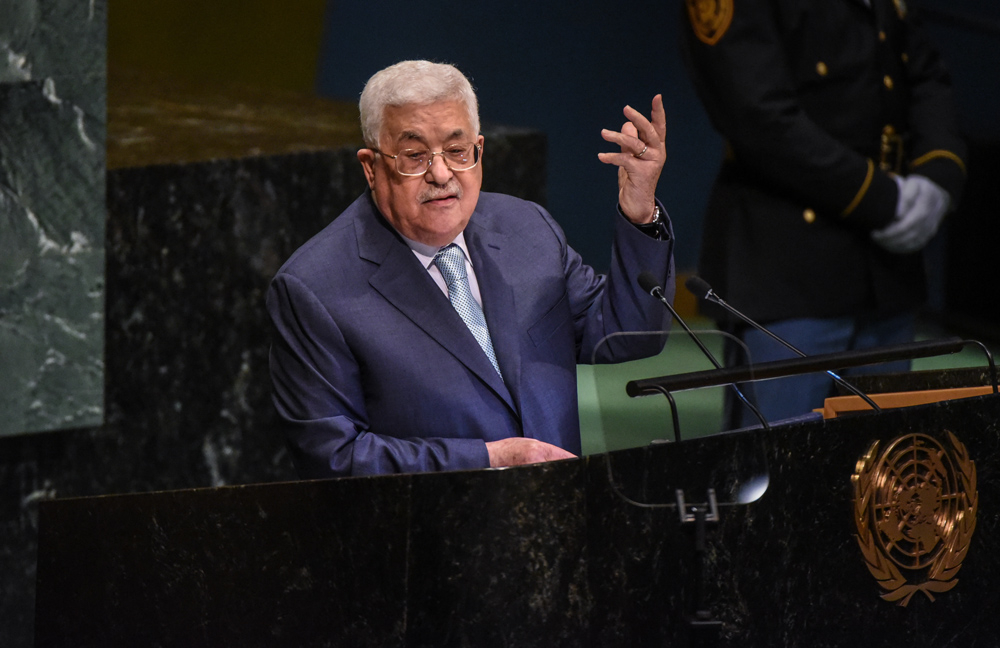
at the UN. Pictured: Palestinian Authority President Mahmoud Abbas 
addresses the  UN General Assembly on September 27, 2018 in New York City.
 (Photo by Stephanie Keith/Getty Images)

A Palestinian mother of three has accused the Palestinian Authority (PA) security forces of torturing her and threatening to rape her during the two months she was held in a PA prison in the West Bank.
The accusation by the woman, Suha Jbara, 31, came on the eve of PA President Mahmoud Abbas's visit to New York, where he is scheduled to assume the chairmanship of the largest bloc of developing countries in the United Nations, known as the "Group of 77 and China."
As chairman of the group, which represents 134 nations, Abbas and the "State of Palestine" will negotiate and co-sponsor proposals and amendments on various developmental, humanitarian and legal issues that are on the agenda of the UN


On January 11, Jbara, who was released last week from detention, held a press conference in Ramallah in which she detailed the various methods of torture she experienced at the hands of her Palestinian interrogators. Her horrific experience, however, does not seem to be on the agenda of the UN or the Group of 77 and China, headed by Abbas. Apparently, the UN group's members, who voted in favor of naming the "State of Palestine" as chairman of the group, do not care much about the human rights record of the PA security forces in the West Bank.

Jbara, a dual citizen of the US and Panama, was arrested by the Palestinian Authority security forces in early November 2018 at her home near the West Bank city of Ramallah. According to Jbara, she was accused of "illegally collecting donations" for families of Palestinians killed or wounded during clashes with the Israeli army.

Bizarrely, the PA is accusing Jbara of something that the PA itself has done for years and is still doing: paying salaries to Palestinians in Israeli prison and the families of Palestinians killed while carrying out attacks on Israelis. According to Jbara, her interrogators also accused her of "collaborating" with Israel. During her detention, she went on hunger strike for 27 days.

The torture, according to Jbara, included pouring cold water on her face, solitary confinement for several days, strip-search, sleep deprivation, lengthy hours of interrogation and verbal abuse.

"The first stages were the worst," Jbara told the Palestinian Wattan TV station.
"They interrogated me for several hours, without taking into consideration that I felt sick. They moved me from one office to another. I saw a number of detainees who were blindfolded and handcuffed. The interrogators were pouring cold water on their faces and some of the detainees were lying on the floor. It was a horrifying experience for me."
Jbara also said that the Palestinian interrogators threatened to take her three children away from her. "They used my children to blackmail me," she reported. The interrogators apparently also threatened her mother, her sisters and her with sexual assault. "I'm now in a very bad health condition," she said. "I even have difficulty walking."

Last month, a representative of Amnesty International met with Jbara, while she was still being held in Palestinian detention, and heard about her brutal treatment at the hands of her interrogators. "The Palestinian authorities must urgently investigate the torture and ill-treatment of Suha Jbara, an activist who has told Amnesty International that she was beaten, slammed against a wall and threatened with sexual violence by her interrogators," the organization wrote.

According to Amnesty's report, Jbara described how, upon her arrest, she had a seizure, lost consciousness and was taken to a hospital. Armed security officials later dragged her barefoot, out of the hospital, and transferred her to the Jericho Central Prison.

There, when she asked for a drink, a male interrogator threw water in her face, slapped her, punched her in the chest and back, and threatened her with further violence. She was blindfolded and handcuffed throughout her interrogation, and was not allowed to drink water or use the lavatory.

"He insulted me all the time," she said, "used very dirty and violent sexual language, threatened to bring a doctor to look into my virginity and say that I was a whore, and threatened to hurt my family and to take my kids away from me."

According to Saleh Higazi, Deputy Director for the Middle East and North Africa at Amnesty International:
"Suha Jbara has described her torture in harrowing detail. In her testimony she gives an account of ruthless interrogators who have shamelessly flouted Palestine's obligations to treat prisoners humanely and violated the absolute prohibition under international law of torture and other cruel, inhuman or degrading treatment."
Yet, Jbara's story has barely attracted the attention of the international mainstream media. As far as many foreign journalists covering the Middle East are concerned, a Palestinian woman complaining about torture in a Palestinian prison is not newsworthy. Had she been detained by Israel, Jbara would have most likely made it to the front pages of the world's leading newspapers and magazines in a matter of minutes.

This is the kind of story that the "State of Palestine" does not intend to raise during its chairmanship of the largest bloc of developing countries at the UN. It seems that, from the point of view of the Palestinian Authority leadership, Jbara's ordeal does not fall within the category of human rights.

The PA regularly complains about human rights violations of Palestinians held in Israeli prison for security-related offenses. But when the PA's own security forces detain and torture a mother of three, Palestinian leaders are found elsewhere -- like at the helm of a UN bloc.

Actually, Palestinian leaders can rest easy concerning their torture of Palestinians. By being selected to head the bloc of developing countries, Abbas and the leaders of the "State of Palestine" will be in the company of countries rewarded for human rights violations -- including Saudi Arabia, Syria, Iraq, Venezuela and Yemen -- just elected as the vice-president of the United Nations Entity for Gender Equality and the Empowerment of Women, despite Yemen being ranked "as the worst country in the world on gender inequality (149th out of 149)" -- as well as several countries in Africa and Asia. That group exemplifies the old saying: birds of a feather flock together -- and these birds are definitely of the predator type.


Monday, January 14, 2019

Closing a 2,000-Year Cycle


Monday, January 7, 2019

Social Revolution of Arab Women in Israel

 The status of Arab women in Israel is improving significantly. Hadas Fuchs, a researcher at the Taub Institute, published a study in 2018 on the integration of Arab women in the labor market in Israel. 

The most striking detail of her research relates to a revolution in the education of Arab women: 15% of students in higher education in Israel are Arab women, even though the proportion of Arab women among the general population is only 10%. In fact, the number of female Arab students in higher education has doubled since the beginning of 2000. 

As a result, women in Arab society are much more educated than men. Female students at Arab high schools comprise 52% of students studying computer programming and sciences, 55% in electronics, 59% in mathematics, and 70% in chemistry. The employment rate of Arab women jumped from 35% to 40% in the past year alone.

Israeli-Arab captain of women’s basketball team. 

Shahd Abboud, who plays for the Hapoel Petah Tikvah women’s basketball team in Israel, opened the 2018/19 season as their new captain, making history as the first female Arab captain of a professional Israeli basketball team in the top league. 

Bedouin woman joins Israeli police rescue unit. 

Rana Jaboua, a resident of the Bedouin Negev village of al-Fara’a has become the first female Bedouin in Israel to join the Israel Police Rescue team, Jaboua is part of a unit that helps hikers in the Judean Desert if they become lost or injured.

 Rana Jaboua


Israeli Bedouin Policewoman Blazing Trail  

Recently, Israel dedicated new police stations in the Arab villages of Jisr azZarqa and Kafr Kanna. Four days later, a short video on Facebook showed Sabrin Saadi, a young and also the first policewoman from the Bedouin village of Basmat Tabun, making her way to the Kafr Kanna station in her uniform wearing a hijab, walking past a group of Arab demonstrators. 

Saadi's father, Ali Saadi, said, "We are part of this society, so we should serve it. The people attacking her are a gang of wild kids with nothing better to do with their lives. They should go find themselves and think about what, if anything, they have actually done on behalf of their community."